Saturday, 2 November 2013

The Japanese are some of the skinniest and most gentle people in the world, so it’s a little ironic that the national sport of Japan involves two very overweight men trying to shove each other out of a ring wearing nothing more than a silk thong.

Painting of sumo wrestlers in the ring 
On September the 22nd (yes that is how far behind I am on this blog) we went to Tokyo for the day to watch some fat men wrestle. The truth is that it’s not just flab but there is a whole lot of muscle underneath it all. These men are huge in height and weight. They weigh anything between 29 to 40 stone and they are extremely flexible.

Barton, Ali, Tom,Cheryl and I outside the Ruogoku Sumo Hall in Tokyo
On a typical day they are consuming roughly 20 000 calories in two huge meals (the recommended intake for a healthy active man is 2 500). A typical meal is Chankonabe (stew filled with fish, meat, vegetables and tofu) which is accompanied by 5-10 bowls of rice and washed down with copious amounts of beer.

I was expecting to be bored after the first few matches but it was simply fascinating to watch as it’s a very unique sport that has kept its traditional etiquette and rituals. It may seem superficially simple; however, sumo wrestling is actually quite complex and requires not only strength but agility and skill.

A rikishi (sumo wrestler) loses if any part of his body lands outside the ring or if any part but the soles of his feet touch the ground.

Raising of the legs - a symbolic movement
Wrestling in the ring


Lower division wrestlers kick start the day’s events at 8:30am, however the majority of spectators (including ourselves) arrive about 2:30-3:00pm to watch the higher ranked divisions. After entering the ring the rikishi goes through a series of symbolic movements. To cleanse his mind and body, the rikishi rinses his mouth with water, the source of purity, and then wipes his body with a paper towel. He then extends his arms to the side and turns his palms upwards to show he is concealing no weapons. And finally, to drive evil from the dohyo(the ring), the rikishi lifts one leg to the side high in the sky, and then the other, bringing each down with a resounding stamp on the ground. Just before entering the dohyo the rikishi also scatters a handful of salt to purify the dohyo.

A Rikishi scattering a handful of salt
Apart from a silk mawashi, a thong to me and you, the rikishi are almost naked. They squat and face each other with their fists on the ground and proceed to glare fiercely at each other. This is called the shikiri. They engage in a kind of “cold warfare” going back and forth (for up to 4 minutes) before waiting for the right moment. The fight itself can be over in seconds! The best matches are always when there is an underdog or one is significantly larger than anther. One match we really enjoyed was a rather slim, muscular rikishi vs the largest rikishi of the bunch. Amazingly, in this match, much to the crowd’s enjoyment, the underdog was victorious!!!

What I loved most about this sport was how disciplined it all was. There was no arguing with the ref, no swearing and certainly no rolling around on the floor “crying” in pain! There is so much money to be made in this sport, but you certainly wouldn’t be able to tell by their reactions after winning a match, they take cool, calm and collected to another level.

On top of their salaries, wrestlers also earn money through sponsorships and other means. Kensho is when sponsored banners are bought up on stage as advertisement by prestigious companies. Each banner costs the company 60 000 Yen (£380) and each fight can have up to 50 banners. Once the match is over, the 60 000 Yen from for each banner is split, the winner will accept an envelope containing 30 000 Yen in his right hand and 25 000 Yen will be deposited in an account for the rikishi at his intai. 5000 Yen is used to pay various taxes. Now if there are 50 banners, you multiply those figures by 50 and that is a lot of money for a minute’s work. Best hourly pay I have heard of in a while.
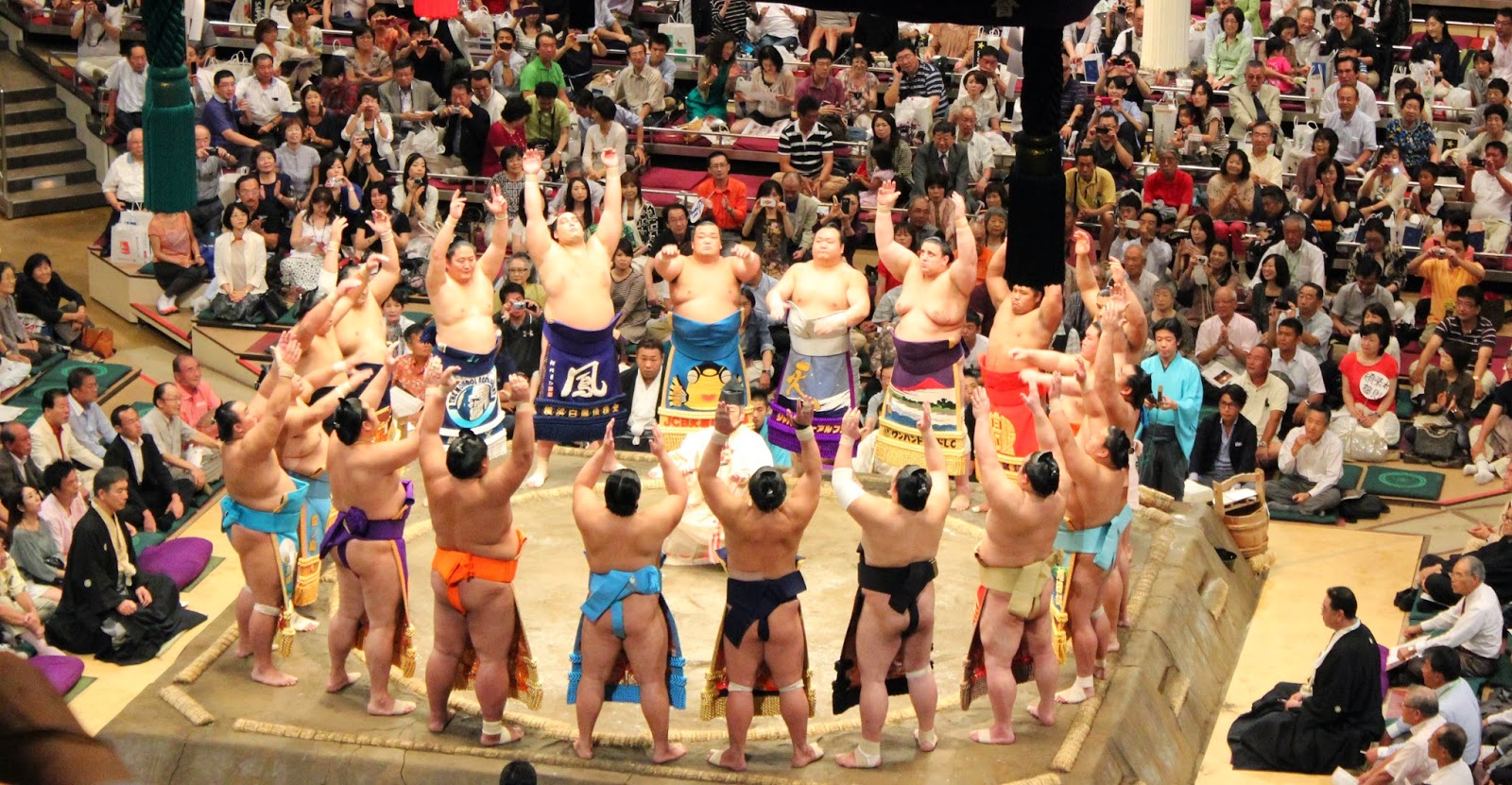
dohy-iri ceremony (entering of the ring)
 Now, I am sure that if any of us won that kind of money in a minute or two we would be fist pumping the air running the risk of shoulder dislocation. Famously, a sumo wrestler named Asashoryu did just this (well not fist pumping, but gently raised his arms and smiled) and subsequently shocked and horrified the Yokozuna Deliberation Committee. He was promptly issued a warning for dishonorable and unsporting behaviour and labelled the “bad boy.”

I love how sumo has managed to survive with its formalized rituals and traditional etiquette intact. It really is unique. Amongst the ceremonies that take place is the colorful dohy-iri or entering of the ring. Before the tournaments being the wrestlers enter the ring wearing a glorified apron which are made from silk with elaborate embroidery and cost anywhere between 400 000 – 500 000 Yen (£2550 - £3200).

It is a great day out and the cheapest tickets only cost us 4000 Yen (£25) and I highly recommend going! It’s another thing ticked off the “things to doing Japan” list!!


Marion 

p.s I forgot to mention about my day cooking! As most of you know I am a pro in the kitchen, I am the next Mary Berry *cough cough*! I recently went to Izu-nitta, a small village nearby for the day. I met up with some lovely girls and had a Japanese cooking lesson. We learnt to make pressed sushi, Japanese spring onion and tofu soup, tempura vegetables and prawns and a jelly and red bean dessert. The event was free and the kindness of the Japanese still continues to touch me. The volunteers picked us up from the station, bought all the ingredients and took several hours out of their Sundays to teach us. I met some lovely people and it was great. Master chef I am coming!!

The girls!
The team!


Friday, 18 October 2013

Even though I am a little behind on the blog, I absolutely love doing it. My blog is now reaching many people across the world that I have never met. I have recently had a number of people email me, some to compliment me on my art and others to ask questions about teaching in Japan. It’s a pleasure to help people to hopefully achieve their dreams as I live mine. Today, I even received an email from a former teacher of my school (she taught here about 10 years ago) who coincidently just stumbled across my blog, it was a lovely thought of her to drop me an email.

It’s made me realise how much I regret not writing a blog/art for my travels in South America and even just less adventurous times like university and college. Although my most recent piece of art is not relevant to Japan, I still wanted to share it with you all. It’s for a good friend I met whilst in Peru, he commissioned a small piece of art for his home in Hawaii. Of course I chose to paint the most iconic image of Peru, Machu Pichu. John, I know you religiously read my blog so I hope you liked this one-off piece for you. You never know one day it may be worth a penny of two (a girl can dream) so keep hold of it.

Machu Pichu - A painting for John a friend in Hawaii
Back to Japan, and this blog is about the weirdest thing I have done in Japan yet. When I thought about coming to Japan I was aware that I would not be tucking into a delicious Sunday roast smothered in gravy for a long while, but more like fish, more fish, rice and some more rice! What I didn’t expect was one of Japans greatest dining specialities: themed restaurants.

In England, when you hear of themed restaurants, you will probably think the likes of hardrock café and TGI Fridays, but Japan has this and more. Look past the sushi and this is Japans second greatest dining speciality. From medical prisons to maid cafes, opera houses to Disney restaurants, Tokyo is exploding with quirky, bizarre, laughable dining experiences.

You can be served by ninjas or dine in an Alice and Wonderland themed restaurant. But Ali opted for Alcatraz ER, a medical prison themed restaurant. This is the granddad of all themed restaurants, the original, the trend setter. I honestly couldn’t tell whether it was meant to be a prison, a hospital, a medieval dungeon who knows! But it added to the eccentric appeal, and accentuated the fact that Japan is crazy!!!

Upon arrival, you have to state your blood type to enter. Once we confirmed our booking with a rather skankily dressed nurse she grabbed Mary, put her in some sort of machine which categorised her as unquestionably crazy, handcuffed her and led us to our cell! We were already in fits of laughter. We were given our medication (nuts and rice crackers in a polystyrene cup), a menu to browse and instructed to bang on the cell bars with a metal bar for service.  

Our cell for the evening!
The aesthetics are actually rather good, the cells are dark and dingy, blood is smeared up the walls, jars of embalmed body parts line the shelves and you even walk over a rather convincing disembowelled body under the floor. Not even the toilets were able escape a make-over.

Heads were often thrown into your cell or a container for a cocktail. 
You can order a range of dishes from penis sausage to titty rice, dead chicken in a cage to blue curry, all of which arrive in metal surgeon dishes used during operations. The drinks are also inaptly named; our choices included pussy juice (which comes with a vibrator), sperm, beer which arrived in a urine test bottle and a peach cocktail in a baby bottle.

Once you become as comfortable as you can be whilst sat in a small cramped cell it got interesting. Suddenly, with no warning, the lights went out, a loud siren started wailing, and the strobe lighting began. Then queue the escaped psychopathic prison convicts, dressed in a variety of costumes including clowns, shrieking and screaming whilst running around looking for a victim and throwing plastics heads at you.

The most bizzare moment though happens at the end, the nurses and psychopaths all walk around with massive fake sundaes with Christmas lights and sparklers all over them, whilst a Disney sound track blares loudly. There is no explanation, this is Japan and this is a themed dining experience…

The break out! The majority of the "show" was in the
dark so sorry for the poor photo quality! 
The cells! 
The food is not five star but it’s another thing ticked of the “things to do in Japan” list! 

I have lots of experiences to blog, I am trying to catch up... promise! My life is just super exciting and jam packed right now!

Thanks for reading! 

Marion

Tuesday, 1 October 2013

2nd August was our final day in and around Kyoto, so what better way to explore the city than by bike. Usually bike hire in Kyoto costs roughly 1000 Yen (£6.50) a day to hire, but our hostel was offering a day’s hire for a mere 500 Yen! Bargain! Its such a good way to get around!

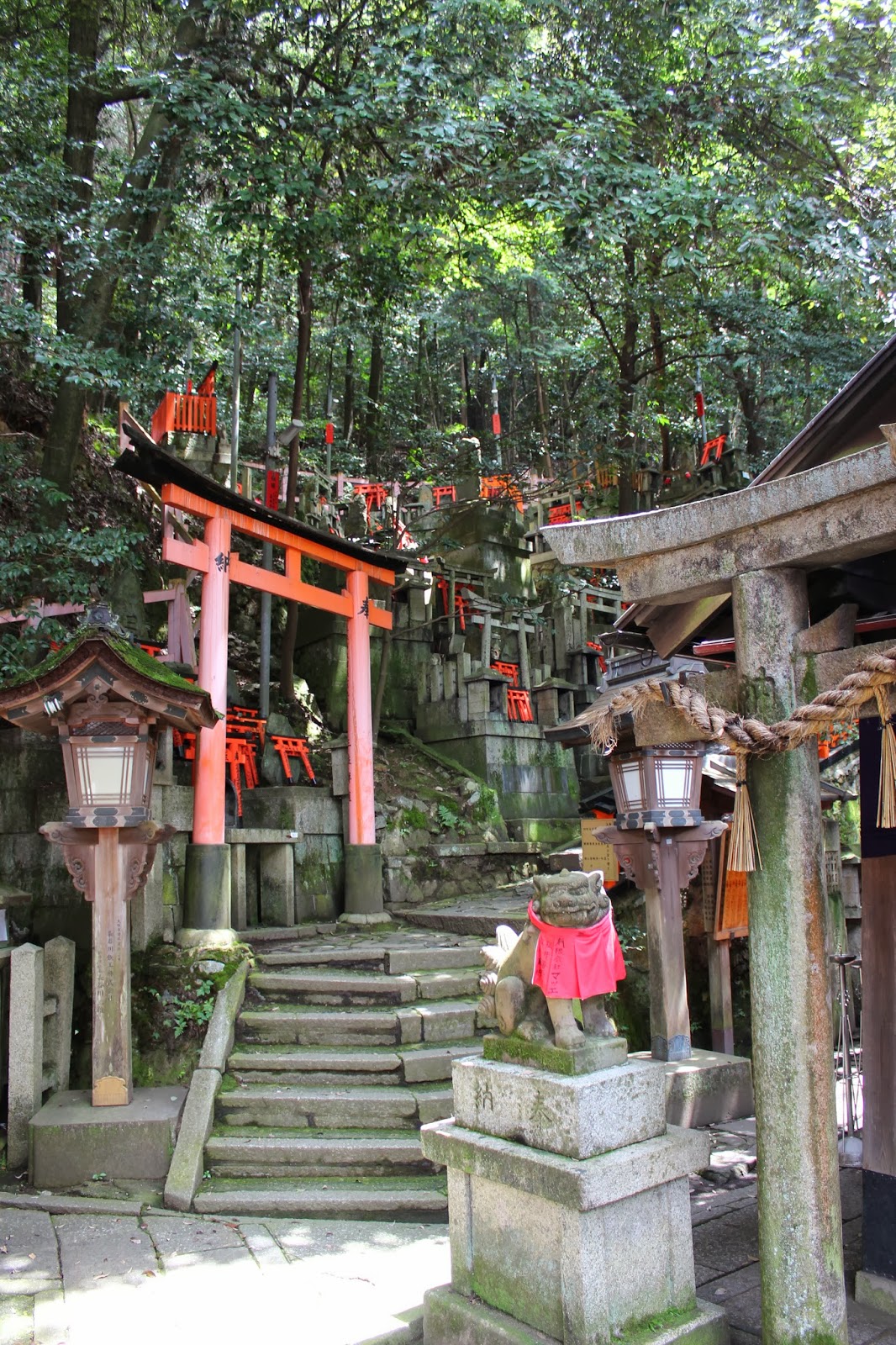
Our first stop was Fushimi Inari Shrine, which has ancient origins predating to the capitals move to Kyoto in 794. Fushimi Inari is a National Heritage site and the most important of several thousand Shinto shrines dedicated to Inari, the Shinto god of rice. Inari shrines are instantly recognizable by a pair of foxes which keep guard at the entrance. Capable of changing shape and vanishing in an instant, foxes are sacred in Japanese mythology and are said to be messengers for the goddess.

Painting of one of the foxes near the entrance of Fushimi Inari Shrine 
The central complex alone is beautiful and certainly worth exploring, at the very back of the shrines main ground is the entrance to the torii gate covered hiking trail. The trail begins with two dense parallel rows of gates call Senbon Torii (“thousands of torii gates”), it is this image that always features in many Japanese guide books. Looking down through the torii gates and these iconic aisles of torii gates appear endless. There are tens of thousands of vibrant, vermillion arches which form a path that winds through a forest and up the mystic and sacred Mount Inari.  

The Romon Gate stands at the entrance of the main complex
The Inari deity (god) is well known as the god of agriculture and business. As such, Fushimi Inari Shrine is frequented by businesses and businessmen and women praying for success. The torii gates are donations by individuals and companies in hope that it will bring them good fortune, costs start from roughly 400 000 Yen (£2500) for a small sized gate and increases to over one million Yen (£6400) for a large gate. You will find each torii bears the name of its donor on the left and the date sponsored on the right. Some torii are ancient and in need of repair, whilst others are more recent indicating that this religion is still very much alive today.

Senbon Torii - the entrance to the hiking trail


Torii Gates


One of the many sub-shrines on the trail
You can’t say you have properly visited Fushimi Inari Shrine until you have made the 2 hour trek up and around Mount Inari. As you venture further along the trail, not only do the torii become less dense, but so do the people, making the journey quiet and peaceful. On the way up there are numerous sub-shrines, each are graced by the presence of a fox and many ornamental sized torii (bought by those with a few less pennies than the high flying businessmen), a few tea houses are also dotted about. Visitors are free to walk as much as they wish before turning back; many will stop at the Yotsutsuji intersection (about a 40 minute walk) which offers beautiful views of Kyoto city.   

The trail is often frequented by dog walkers, joggers and pilgrims all year round and it was lovely to be greeted with a hearty konnichiwa as they pass.

We did the full hike, the shrine and the tens of thousands of torii are impressive, beautiful and serene. We really enjoyed spending the morning here although it appeared that Tom and James had both taken sweating to another level. It was extremely humid and hot all day!

A very busy Nishiki Market
Mini octopus with eggs inside
Next we cycled along the river and headed towards central Kyoto to see what the city centre had to offer. 

I wanted to visit the Nishiki Market, as it was a must see in my guide book. It is a narrow long shopping street lined with hundreds of shops and restaurants. Known as “Kyoto’s Kitchen” this lively food market sells all the weird and wonderful culinary delights that Kyoto is famous for. 

We tasted many delicious and not so delicious samples, we call it food roulette. I particularly enjoyed the dry chilli shrimp. I've heard that many of the stores have been running in the same family for many many generations. It was great to see a thriving market which is  very much a central part of many locals lives. 


Finally, after a pit stop for some delicious but expensive frozen yoghurt, we cycled to Gion, Kyoto’s most famous geisha district. It is filled with restaurants, shops and ochaya (tea houses) where geiko (Kyoto dialect for geisha) and maiko (geiko apprentices) entertain. Many of the streets maintain their traditional wooden frontage, the most popular is Hanami-koji Street which accommodates many restaurants and the most exclusive and expensive ochaya (teahouses).

I was very lucky to catch a glimpse of a geiko on her way to prepare for an engagement at an ochaya that evening. As to respect her I tried to keep my distance so that she could carry on her day-to-day life, however many tourist act like ruthless paparazzi resulting in an increase in complaints in recent years.

A Geiko on her way to prepare for an engagement at an ochaya that evening
Overlooking the river

After a long and sweaty day, Tom, Ali and Mary wearily cycled home. Giant and I explored the area a little more. We had a little wonder around nearby Yasaka Shrine and Kenninji Temple, took a brief stop along the river to take in the beautiful views, and made several stops in shops to sample Yatsuhashi. Yatsuhashi is a small sweet famous in Kyoto. It is soft thin squares of cinnamon scented mocha (sticky rice) dough, folded into triangles and filled with a sweet paste such as azuki bean, apricot jam etc. Scrumptious!

Finally, Giant and I headed to the hostel to de-sweat and scrub up for our final night together. We headed back to Gion for Shabu-Shabu and a wonder round the city at night. It was lovely and romantic, until we went to purchase some pudding in a small convenience shop and some tramp in the queue weed all over the floor. Delightful!  


Shabu-Shabu in a small restaurant in the Gion district 


On that note, this bought our trip to a close; shattered we fell asleep as soon as our heads hit the pillow. Saturday was spend slowly making our way back to Numazu on the local train (it took over 8 hours due to a problem on the track) and our final super at Hamazushi (a chain sushi restaurant).

I loved planning the trip and those of you who know me will know that it was of course run with military precision. Everyone very kindly bought me a lovely yukata (traditional summer garment worn at festivals) to show their appreciation.  It was perfect for Ito summer festival for two reasons, firstly I could wear my very own yukata and blend into the crowds, secondly, it was a great blanket for when I missed the last train home and had to spend the night on a public bench and in McDonalds.

This post brings our main summer trip to an end, and I really hope you have enjoyed my blog posts. My next post will be about our evening in a themed restaurant in Tokyo!!!

Marion 

Wednesday, 25 September 2013

Today’s plans were to head to what turned out to be my favourite place in Japan yet, the beautiful town of Nara, followed by a stop at Oksaka Aquarium in the late afternoon!  Nara was Japan’s first permanent capital in the year 710, it is a very charming antiquated town. Parts of the old town have retained its share of ancient temples and old shops from its feudal past. It is like an open air museum of traditional life from a century ago just with a few additional overheard power lines and Toyota cars.

Feeding a deer
Nara is only a 50 minute train ride from Kyoto. It has a great advantage of having the majority of attractions grouped together in one huge park enabling you to walk everywhere.

The cutest attraction by far is the 1 200 wild sika deer that freely roam the huge park. They are extremely placid so you can walk up to them and stroke them no problem.  It is a strange experience to wander around and see deer at a bus stop deer, in shops, in toilets…everywhere!  Some loose change (150 Yen) will get you some sika senbei (deer crackers), they look like something you may pick up at the supermarket if you were on a terribly unexciting diet. There are kiosks dotted around the park run by elderly women. The deer seem to recognise that the kiosk ladies are not a walking vending machine, when too many congregated near the kiosk they are shooed away with a broom.

Many deer began to surround us and took a strong liking to chewing my dress.
Cute, yes, but mix that with hunger and persistence and they become cheeky and determined. Whilst some deer lazed under trees, most were engaged in some form of chase with their human visitors, nipping at clothing, legs, arms etc. My biscuits lasted approximately 20 seconds, as soon as I walked away from the kiosk, deer began running towards me. Believe me it’s actually quite scary, don’t be surprised when one head butts you or bites you because you didn’t give it your last cracker. Some have even learnt to bow, which is adorable.
All of us at one of the lakes in the park

Within the park, finely wooded with ancient trees, are many historic old buildings, including temples and pagodas, and a number of large lakes. The park is packed with many temples, but you do get to that point in Japan when you start to feel like all temples look the same. Seen it, done it! 

Mary, Tom and Ali had given up looking at more temples. As this may be our first and only trip to Nara James and I decided to continue on and I am so glad we did. 

The sight of Todaiji temple was particularly magnificent and completely unexpected. It is one of Japan's most famous and historically significant buildings. It was the head temple of all Buddhist temples in Japan, and grew so powerful that the capital was moved to Nara. It is the world’s largest wooden building, and the main hall hosts Japan's largest bronze Buddha. Along the approach to Todaiji stands the Nandaimon Gate, watched over by two fierce looking statues which represent the Nio Guardian Kings (these are now national treasures). 

Todai-ji - a very prominent and magnificent wooden building.


James and I at the entrance.

The Buddha is 15 metres tall and it is flanked by two Bodhisattvas. It is extremely difficult to give a sense of scale, but his open hand alone is taller than you r average human. 

  
Binzuru
Apart from this, there are two main quirky details about the temple. One of the pillars has a hole which is the size of one of the Buddha’s nostrils. It is said that if you pass through it, you will be blessed with enlightenment in the next life. But, there’s a catch. You either need to be a child or extremely slim to be able to pass through. 

Thankfully, nobody got stuck on their quests for enlightenment that day.

Outside the temple is a statue of Binzuru, the most widely revered disciple of Buddha. It was creepy. The Japanese believe that if you rub a part of its body and then the corresponding part of your body, you will be cured. 

The forests surrounding the temples are also beautiful and offer a great hide away from the strong sun. Strolling through Nara Park was very relaxing. A beautiful part is the walk leading to Kasuga Grand Shrine, it is flanked with gorgeous moss covered stone lanterns. It’s a romantic and mysterious sight. The Kasuga Grand Shrine is a UNESCO Heritage site and is famous for the bronze lanterns decorating its interiors.

Hundreds of moss covered lanterns line the path up to the temple
Bronze lanterns decorate the interiors of the temple


Koto (wooden stringed instrument) player at Kasuga Grand Shrine
Later that afternoon we got the train from Nara to Osaka Aquarium, also known as Kaiyukan. The aquarium is located in the Tempozan Harbour area of Osakas bay, and it is one of the world’s most spectacular and biggest aquariums. Tickets cost 2 300 Yen (£15). Marine life is displayed in over a dozen tanks, each representing a specific region of the Pacific Rim. The central tank represents the Pacific Ocean and it is home to two magnificent whale sharks, a few hammerhead sharks, some manta rays and a variety of fish. You start your tour on the top floor and spiral your way down around the central tank. Many of the tanks also stretch across several floors, giving you a great view of the animals from different depths and perspectives.

 Gazing into the large central tank.


My favourite was the jelly fish tanks. I literally had my nose pressed up against the glass; I was mesmerised by the truly beautiful but dangerous animals. 

James amongst the jelly fish!
Another jam packed day, another early night in preparation for our last full day in Kyoto.

Marion

Tuesday, 24 September 2013

On the second day of our tour we explored Kyoto, more specifically the North western side of Kyoto.

First stop was one of Kyotos best known tourist sites, Kinkakuji or more commonly known to us as the Golden Pavilion. It is only 500 Yen to enter the grounds but as you can imagine it is always busy. It really is a magnificent building, although it looked smaller than I imagined. The top floors of the Zen temple are completely covered in gold leaf and it is built over a large pond. The pond acts as a mirror beautifully reflecting the temple.  The temple is not the only site to see in the temple grounds, you can walk around the pond and through the beautiful gardens that have kept its original design. It’s a definite must see, but it is very touristy! This is a painting of Kinkakuji. 


We decided to stay in Western Kyoto and make our way across to Arashiyama, where the famous bamboo grove is located. We walked about 20 minutes from Kinkakuji temple to a nearby station and rather than getting the conventional JR train we decided to hop on the Keifuku electric railroad. This is one of James’ favourite memories of our trip due to its historical past and leisurely qualities away from the tourist hustle and bustle. Boarding the train we stood near the front of a single car. James and I stared ahead out the front window in order to share the best view with our conductor. The metal wheels were clanging over the track, the breaks were squealing and the horn occasionally blew to warn nearby cars. All too soon, we arrived at our destination. To pay the fare we dropped 200 Yen in a plastic box at the front of the station.

Model James
Arashiyama Station is an attraction in itself. The station reopened only a few days before our arrival with a brand new interior design scheme. There are a number of little shops selling traditional sweets and beverages as well as plenty of places to sit. The east side of the station features beautiful acrylic poles draped with traditional yuzen dyed kimono fabrics, illuminated from within by LEDs. It is referred to as the “kimono forest” and it seemed to bring out the “model” in James.


Arashiyama is a pleasant, touristy district and it is where the famous Sagano bamboo grove is located. A path cuts straight through the bamboo grove which allows you to stand amidst the soaring stalks of bamboo. If you pick up a Japanese guide book you will probably see pictures of the bamboo grove, it is one of the most photographed places in Japan, but no picture can capture the feeling of standing in the midst of this sprawling and towering bamboo grove, it’s nothing quite like that of any forests we know of.  The setting is truly picturesque as the sun’s rays shine through the grove and a soft breeze can be heard.

Sagano bamboo grove 
Sagano bamboo grove 


Just before setting off on our day out we had seen an advert for a boat ride in the Arashiyama area, our plan was to catch the last boat of the day (3:30pm). As ever, we were running a little behind schedule! It was only until after purchasing our train ticket from Arashiyama station to Kameoka (where the boats were being launched) that we realise that the next train wasn’t until 3:17pm. The leaflet stated that it takes 10 minutes to the nearest station (Kameoka) and another 8 minutes at a fast jog to the launching site from the station. Now I am not good at Maths, but with time against us and the ultra-precise timekeeping ability of the Japanese, it was safe to assume that we were going to miss the last boat. This wasn’t going to stop us from trying, as we dashed out of Kameoka station some men behind us shouted “boat ride” “boat ride.” It looked like the boats were going nowhere as the captains of the boats were running a little behind schedule too. Japanese extreme precision 90, Gaijin luck 1. Thankfully they radioed ahead for us and there was a boat waiting for us.

The cruises utilise traditional style flat bottomed boats piloted by boatmen who guide the craft with an oar and bamboo poles. It is an attraction that is often sadly missed by many tourists. Hozugawa now only serves as a tourist attraction but it used to be an industrial waterway for transporting logs and timber which were used to construct many of Kyoto and Osakas famous temples and castles.

On-board the wooden flat bottomed boat. 
Source: Arashiyama boat ride website
This 16 kilometre, 2 hour journey down the river, travelling from Kameoka to Arashiyama, showcases interesting rock formations, diverse   wildlife and an exciting ravine ride. As soon as you leave the small town of Kameoka, you enter steep forest gorges on either side. It is very relaxing way to see the natural scenery of the largely undeveloped ravine. The majority of the boat ride is fairly calm; however, there are a few sections with some small rapids. At one point in the trip, the oars men took great enjoyment when my lower body got drenched. The oars men were great fun and experts at spotting the wildlife including turtles, cormorants, and even monkeys!! One and a half hours in and were all starting to get a little peckish (more like starving in Ali and Toms case), soon after, our prayers were answered and a little wooden motorboat with a rather rotund man and his wife pulled up alongside and cooked fresh octopus right in front of us.  The boat ride is a little pricey at 3900 Yen (£25) but certainly worth it.

Cormorant fishing 
After two hours we disembarked off the boat in Arashiyama and took a stroll along the river. We were waiting for the Ukai, also known as cormorant fishing to begin. We opted to sit and watch from the river bank but you can pay roughly 2000 Yen (£13) to watch the action up close on a small wooden boat. Cormorant fishing happens in the summer months, and in about a dozen rivers throughout Japan. Each fisherman leads about a dozen cormorants on leashes that swim alongside the boat and dive under water to catch fish by swallowing them whole. The fish are kept in a special pouch in the cormorant’s throat to be retrieved later and are prevented from being swallowed by a snare around the neck of the bird. Each boat has a large fire that hangs from its bow to provide light for the boatmen to steer and the birds to fish by. It was interesting to watch but the fishing only lasted about 15 minutes and I couldn’t help but feel sorry for the cormorants.

After a jam packed day, we hopped on the train back to Kyoto station, ate some delicious fresh sushi and after Tom tried (and failed) to explain poker to my sister and I we turned in for the night

Next stop Nara and Osaka Aquarium! 

Marion 

Thursday, 12 September 2013

After using our home in Numazu as our base for the first few days, it was time to venture beyond our small coastal city!

Hanshin Tigers game in Osaka was the stop on our trip outside Numazu! 
Travelling around Japan is expensive! When I first started to plan our trip I was horrified by the costs, there seemed to be no cheap way to get anywhere. Domestic flights are expensive (although discount airlines are starting to pop-up), the shinkansen (bullet train) costs an arm and a leg, and even a quick road trip costs a fortune due to highway tolls and fuel prices. But I was determined to find another way.

Seisihun 18 Kippu (Youth 18 Ticket) 
The mission was to get from Numazu to Kyoto, which is almost exactly the same distance from London to Chester (my home city in the UK), for as little money as possible. To give you a little comparison, a return ticket, purchased on the day, from London Euston to Chester usually costs me £49.  Numazu to Kyoto by Shinkansen costs roughly 22 000 Yen (£142) return!! Those who come to Japan on a tourist visa can get a 7 or 14 day rail pass for the Shinkansen, but as you can imagine these cost hundreds and are not available to those on a working visa or a working holiday visa.

After a bit of a search I came across the Seishun 18 Kippu (youth 18 ticket), and what a find it was. The name is quite misleading. Whilst JR markets this ticket to poor university students and young adults, everybody and anybody can purchase and use it.

The ticket costs 11 500 Yen (£71) and is sold three times a year (so check before you travel to see if its available as dates change every year). Luckily the summer ticket was on sale the day before we departed! It is one ticket, but is serves as an individual ticket for 5 days (the days don’t have to be consecutive). So you can travel as far as you like in one day all for the princely sum of 2 300 Yen (£15). Furthermore, the ticket can be used by more than one person. Instead of only you using the ticket for 5 days, you could use it one day but with five people – this is exactly what we did.  The catch…you can only use local JR trains (so it is slow).

On the 29th July, after realising that our clock was 10 minutes slow, we made a mad and sweaty dash to the station, making it just in time for out 5AM train (thankfully, I had purchased our ticket the night before). We hopped on the train and embarked on our 6 hour journey, Numazu- Hamamatsu – Toyohashi – Ogaki –Maibara – Kyoto.  Thanks to Japanese precision the journey went without a hitch and we even managed to catch some zzzs. We arrived just before Midday in Kyoto, pleasantly surprised with how the journey had gone.

I had made the decision to stay in one hostel based in Kyoto and use it as our base for a week of travelling. We stayed at the piece hostel just a short 2 minute walk from Kyoto’s main station. I have to say it was the best hostel I have ever stayed in! In fact, it was more like a hotel; the facilities were amazing, friendly staff, free breakfast and most importantly extremely comfy semi-double beds. We stayed in a shared dorm for only 2 300 Yen (£13.50) per night. I honestly would pay double that to stay again!

After a quick pit-stop in the hostel we jumped on the train to Osaka, as we had booked tickets to see a baseball game. Our youth train ticket was still valid until midnight that day so it saved us even more money. I have since worked out that the youth ticket saved us roughly £80 EACH that day.

    
Me in Osaka castle gardens
We had a few hours to kill before the game, so we enjoyed some delicious ramen and jumped on the subway to see Osaka castle. Originally the castle was a display of power; it is a famous landmark, popular sightseeing spot, and the symbol of Osaka. It is a grand sight that can be matched by no other castle in Japan. We also met a Japanese man that taught us some origami and gave me a hand painted book mark!

James and I crossing the bridge to the castle

Bang bang! What was that? Oh it’s just Mary making a gun with her fingers and pointing them at a 
random passers-by to see his reaction! Obviously his reaction was one of utter bemusement!  Why? The Osaka Bang of course! According to the Osaka bang video (I tried to add the video to my blog but failed, I am technically inept) the people in Osaka know how to have a good time. If you make a gun with your fingers and point it at them their reactions are meant to be priceless. If you don't believe me fllow this link and check it out:


http://www.youtube.com/watch?feature=player_detailpage&v=WknMhk9J_EE

But after Marys first and failed attempt I started to doubt this theory. Did this stop the boys? Oh No! Tom then pretends to pull out a machine gun on the subway system. Oh Dear! After many attempts (mainly from Tom) and significant embarrassment I can confirm that this does not work.

Tom, Mary and I ready for the game
After a few hours exploring Osaka it was time for chanting, chanting and more chanting. When most people think of baseball they think of America. However, I can assure you now that Japanese baseball games are extremely popular and very entertaining.  We went to watch the Hanshin Tigers vs Yakult Swallows. I had been told by many of my students that the Hanshin Tigers baseball club has Japans most passionate sporting supporters.

Arriving at the stadium, I immediately got the feeling that this was serious business. Hanshin fans are like no others. Lining the path to the entrance were back-to-back street vendors selling merchandise, in addition to two official Tigers shops. Fans wondered around in a sea of white, yellow and black, wearing Hashin Tigers towels around their heads to combat the high summer heat. Foreigners get a lot of attention at these games, and throughout Japan, because…we are foreign. This attention was certainly accentuated by the fact that we decided to go wearing Tiger oneises. Oh Yes! Primark onesies made it all the way from the UK (thanks to Tom) so we could stand out even more! It is all fun, especially if you need to grab the beer ladies attention. We were also given a free T-shirt each, which was a nice little souvenir (and a good PJ top).

We had the cheapest tickets, 1900 Yen (£12), so we were seated in the outfield on the Tigers side. We finally made it to our seats after many high fives as we climbed the stairs through the crowds. From start to finish I was lost. None of us really had any idea what was going on. However, the atmosphere was electric and it was impossible not to enjoy it.

James and I in the stadium 
Japanese baseball games have people whose job it is to lead the crowd in cheering, and a drummer to keep the crowd together, they are essentially conductors. Every player has their own chant. About 90% of the stadium was Hashin Tigers supporters, so when Tigers were up the whole stadium erupted with the voices of over forty thousand fans chanting things I couldn’t understand and batting their plastic bats. I did join in with one line it went something like “oooh ooooh oooooh HASHIN TIGERS! HURRAY HURRAY HURRAY HURRAY!” The rest we improvised and added our own lyrics too.  

It is forbidden to do the Mexican wave, I am not sure why, so please enlighten me if you know. However, a famous fan tradition is to release tens of thousands of rather dodgy looking balloons into the air immediately following the seventh inning stretch and the singing of the Tigers fight song. Now, we didn’t know about this tradition, but we were passed some balloons by the crowds so we could join in. Everyone released the balloons at the same time making a very high pitch squeal. 

Blowing up the balloons 

Releasing the balloons
Following the game we joined the queue for the subway. Again Japanese precision shone through, yes it was crowded but we were swiftly put on a subway bound for Kyoto with no problems what so ever. More of a problem was the fact that it looked like Tom was going to pass out from the heat. As Tom started to turn an interesting shade of grey, three ladies surrounding him in the queue decided to start fanning him to prevent him for keeling over amongst thousands of lairy Tigers fans.  

It was a fantastic day and I would highly recommend going to a Japanese baseball game. Dress up and get involved!

My next post will be about exploring Kyoto! I am slowly but surely catching up on my blog posts.  

Marion