Monday, 2 September 2013

Of all the iconic images of Japan, Mt Fuji is the real deal. With hundreds of thousands of people climbing every year, Fuji-san has captivating both Japanese and international visitors. This year was extra special and therefore extra busy as on June 22nd 2013, much to the delight and joy of many people, this symbolic mountain was finally officially designated as a World Heritage site by UNESCO.

A simple acrylic painting of a hiker taking in the beautiful morning skies! 
Fuji-san has featured in many of my blog posts. As soon as I knew I was coming to Japan, naturally, climbing Fuji-san was on top of the “things to do in Japan before I leave” list.

Fuji-san is 3776 metres above sea level. Mention that you are climbing Fuji-san and someone is sure to ask whether you have oxygen canisters, a guide, good walking boots, professional clothing and so on..! Most of my students just questioned whether it was a good idea at all. All my adult students showed their concern and worry; many concluded that I shouldn’t go as it’s more attractive and enjoyable looking at it from afar. But, it can’t be that difficult I thought, I mean, if you were to judge the climb purely on the number of people who climb it, you’re likely to conclude that it is not a particularly hard mountain to climb. Hundreds of thousands successfully reach the summit each year, including a man who was 105 years old. So I wasn’t really that daunted by the challenge, I don’t think anyone was to be honest.

I think that my student’s main concern was my decision to take the less conventional way to climb the mountain. The most popular and safest way to climb Fuji-san is to start in the day and stay in a mountain hut near the summit. But, even though we are earning a very good wage, you can’t take the money saving students out of us just yet. Rather than forking out 5500 – 8000 Yen we decided to walk through the night skipping a stay in a hut. Climbing through the night is discouraged by the locals and authorities as weather changes quickly, temperatures are low and visibility is poor. Those who climb through the night are called弾丸登山 (danger-tozan) which means bullet climbing. But not many can say they have climbed a mountain through the night. Challenge accepted.  

The newly elevated status from UNESCO has sent a record number of climbers up Japan highest and most prominent mountain, and on Friday 26th July, we decided to join this year’s craze. The sun was shining in Numazu as we walked through the city to the train station in our hiking gear. At this point I thought that I had packed too many layers, it was sweltering. We jumped on the train to Mishima where we caught a direct bus to Fujinomiya 5th station, to walk the second most popular trail – Fujinomiya trial. The bus cost us 3000 Yen return which is pretty good, but it wasn’t the comfy coach I had imagined, more like an Arriva service bus.  The dream of a return journey with comfy reclining seats and air-con to rest our exhausted bodies was going to remain no more than a just a dream.

As we began to drive to fifth station, the weather began to change remarkably quickly. One minute it was sunny the next it was windy and cold. We arrived at 5th station at 4:15pm which gave us enough time to relax, eat our bento (lunch) that we had bought in Numazu, and play some cards before setting off at about 8pm.

T minus 30 minutes before departure and the heavens opened!! We were hit in the face by the harsh conditions of nature. It rained and rained and rained, the wind had picked up and thick cloud had wrapped around Mt Fuji. It was at this point (a little late) that we realized that we were slightly unprepared. James, Mary and I had forgotten waterproof trousers, Ali had nothing but a Pikachu onesie for extra layers and Michael had the worst walking footwear ever! Not only were Michaels shoes very thin and uncomfortable, but they were not waterproof. Oh No! James and I decided to splash out and get some cheap waterproof trousers from the small shop; thank goodness we did as they were essential when we reached the top.

All smiles at the start before the rain, wind, fog and lightning.
    
All of us
Thankfully the rain began to slow down and we started off in great spirits, laughing and singing, we had lots of energy which felt, at the time, like it would last all night. Very early on in the assent we overtook a large group led by guides using flags to shepherd their followers. Whilst you want to avoid standing in queues, I believe that you shouldn't miss out on one of the most interesting aspects of climbing, which is the camaraderie and unique experience of ascending the mountain among hundreds of equally minded people from across the world. 

The wind got stronger and the cloud got thicker as we climbed higher. At times the cloud was so thick you couldn't see who was in front of you! But when the clouds broke the view was truly incredible. James and I often spent a few minutes catching our breaths and taking in the view. Look down and you are treated to a spectacular light show. The lights from towns surrounding Fuji-san shone brightly and you could see an accumulating snake of lights growing longer and tighter as fellow hikers slowly made their way up. What was really incredible was watching a lightning storm below us.

The sky below us was illuminated by strikes of lightning. Lightning bolts jumped from cloud to cloud, to the ground, to the cities below us. It’s not like watching a lightning storm from the ground, head on, watching were every lightning bolt struck. There was silence, no thunder, no sound, nothing. It was strange to watch the world around us in beautiful chaos whilst we quietly watched on from above. I stopped and started several times on the way up as I was mesmerised by the lightning show below is.

We were far enough away that it didn't feel dangerous. It was simply beautiful. I wish I could have taken photos but they weren't coming out well.

Desperately trying to get warm we joined a loan hiker in a small alcove.
Onwards and upwards! From the very start there was very little shelter we were totally exposed to the freezing air and battering winds. At station 8 we realized that we were well ahead of time and storming up the mountain. There was a small alcove with a man standing in the corning, not moving, not talking, nothing. Despite the fact we had no idea who this man was, it was time to huddle up right next to him as it was the only sheltered spot we had seen for the whole journey. Our topic of conversation at this point… what would bear grills do right now? Ali concluded “he would skin this chap and sleep inside his body.” And on that note, half an hour later our lack of movement meant our bodies were cooling down so we marched upwards.

At station 9 it was 11pm and we were nearly at the top. With no shelter we all piled into the first aid hut which gave us a chance to change out of our sweat-drenched clothing. It wasn't heated but it gave us some much needed shelter from the wind. All the huts were packed with sleeping climbers; there was no room in the huts for any more. Many people huffed, puffed and groaned very loudly in relief as they reached the next station, but two seconds later a small Japanese man would hurry out of his hut to tell hikers to be quiet. It was very comical to watch as his words seemed to go in one ear and out the other, as soon as he turned his back, hikers continued to huff, puff and groan rather loudly.

Then we reached the summit. You are probably thinking that the rest was easy; simply watch the sunset and descent the mountain. Oh boy, are you wrong! In reality, the hours between our final ascent and the sunrise were the most difficult part of the whole ordeal.

You see we reached the summit at around 2:30 am. The sun wasn't scheduled to rise until 4:45am. This meant that we had over 2 hours to wait, wearing only sweat-drenched clothing. It was at this point that our cheap waterproofs which we purchased at 5th station at the start of the hike provided a little more warmth. As soon as we stopped moving, our body’s inner furnace stopped burning, and the cold began to seep through our bodies. There were a few other early arrivals on the peak. Many were snuggled up in their sleeping bags and silver foil wraps. Clearly more prepared than us. All the huts on the summit were closed until the morning, so we all huddled together against a wall and closed our eyes hoping that time would fly. In fact, it was the longest two hours ever. It was at this point I swore never to complain about the heat again, but if you have read my last post you will know that this promise didn't last long.  

Finally it was time to huddle amongst the hundreds of people to watch the sunrise. The sun was stubborn that day, hiding behind thick layers of cloud. But every so often it broke through the cloud. I snapped a few photos but it was so cold and cloudy that after a quick discussion we decided that we’d seen enough, and began heading down the mountain.  

On the top of Japan with my best friend! You most probably cant tell but I had reached desperate measures to keep warm and decided to use my spare leggings as a head scarf. 
We did it!! All of us enjoying the morning sun, such a great accomplishment. 
What goes up must come down! As we headed down the mountain, below the clouds the morning skies were beautiful and the inspiration for my painting.  I found walking down worse than walking up. I am grateful for my good hiking boots. The lack of grip on many people’s shoes made for 4 hours of taking one step and sliding three feet. It was nice to be basking in the morning sun on the way down and to see the mountain huts bustling with tourists. 

A long line of hikers waiting to get to the summit as we
were making our way down. 
The majority of people had just started the climb, so everyone we passed, we often greeted and wished them luck on their way up! I must have said ohio guasimas (good morning) hundreds of times! I loved that everyone want to talk to us, ask us where we were from etc. there was a great atmosphere. In fact Ali came a bit of a celebrity, at this point he had his Pikachu onesie on and many people stopped to point, laugh and take photos.

Finally about 3 and a half hours later we had arrived at where we had started. Time to face a 2 hour bus journey, no air-con, hard seats, aching limbs…. But nothing could stop us from snoozing!  

Making our way down! Its pretty hard not too spot
the Pikachu 
I agree with the majority of people, Fuji-san does look more attractive from afar than close up. However, the views (when there is no cloud) are incredible and the experience of climbing through the night and the early hours of the morning among hundreds of equally like-minded hikers from across the world is very rewarding. What made it for me was completing it with some of my favourite people. We could have been a little more prepared clothing wise, rooky mistake, but otherwise the climb is not difficult and a very rewarding experience.

On a side note, thank you to everyone who is reading my blog!! I've had over 2500 viewers from around the world. I have a passion for art and would love a career that utilises my talent, but its a tough industry to break into. I am going to keep trying though. 

Marion


Thursday, 29 August 2013

“In learning you will teach, and in teaching you will learn.” 

I have just done another article  about teaching in Japan for GaijinPot (the No.1 resource for foreigners living and working in Japan) which includes a small sketch for the website. I  thought I would also share it on here too.

My next blog post, about climbing Mt Fuji,  is ready and I am adding the finishing touches to my painting, so keep checking my blog! 

Many many English books! 


Monday, 26 August 2013

On the 24th July, we all embarked on our first trip outside Numazu. We were bound for Kamakura, just an hour and a half North of Numazu, and an hour South of Tokyo in Kanagawa Prefecture.

Kamakura was Japans first feudal capital. Its glory days coincided with the spread of populist Buddhism in Japan, a legacy reflected in the areas high concentration of stunning temples and statuary. Contemporary residents have added a laid-back vibe complete with many restaurants and summer beach shacks – which can be added to sunrise meditation and hillside hikes as reasons to visit.

The Great Daibutsu - Kamakuras most iconic sight
As we stepped off the train, I grabbed a walking map of Kamakura from the information desk. Kamakuras most iconic sight is an 11.4 meter statue of the The Great Daibutsu (Buddha), and this was our first stop. So how hard can it be to find a massive iconic Buddha? Rather difficult actually! As soon as we started walking we had no idea where we were going. As I have said in previous posts, when you pull out a map in Japan you can pretty much guarantee that a Japanese person will ask if you are okay. True to form, a small little Japanese lady hurried over to ask if we were okay. I said we were looking for the Daibutsu, she turned around the way she came and told us she would take us there.

How kind I thought, but surely it’s not that far, especially as we had a walking map in hand. Half an hour later and we were still climbing a mountain, Tom was dying from the humidity but the Japanese lady continued to bounce along merrily carrying her weekly shop. Often I think Japanese people want to talk to English people to help brush up on the old English skills, but this lady happily just marched in front and 40 minutes later, dropped us off right at the entrance of the Great Buddha, and walked back the way we came.

It was 500 Yen to see the Buddha, it was raining earlier in the morning so it was rather quiet which was nice. So we came to Kamakura to see the Great Buddha and well it was a big, massive Buddha, exactly what you expected! Obviously, it was a great sight and the Buddha is hollow so for an extra 20 Yen visitors can view the interior.

Ink and water colour sketch 
Tom, James, Ali and I  - we lived together at
university for 3 years and the last place we thought
we would be re-united is Japan! 


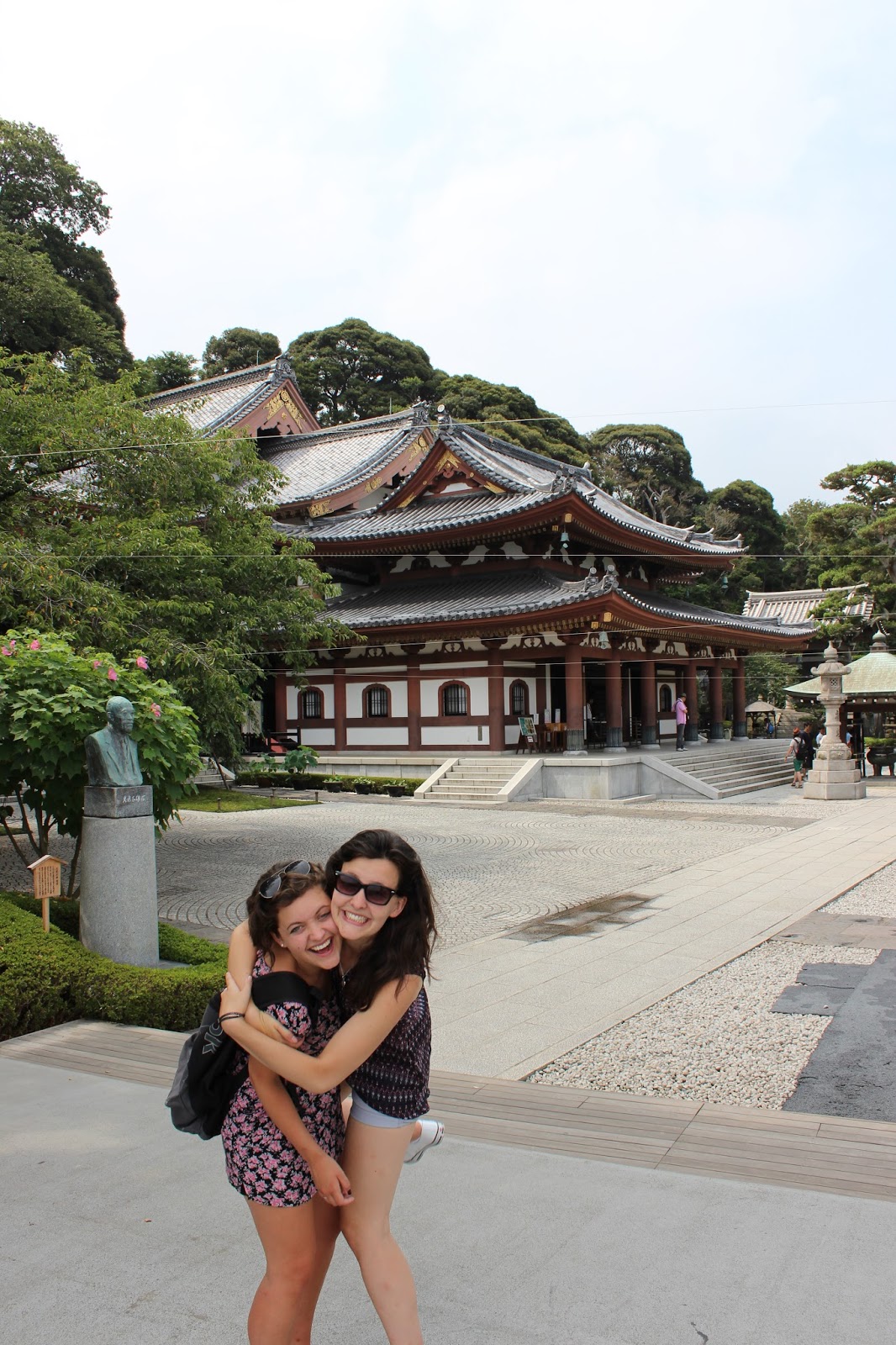
Next, we visited Hasedera Temple, which was a short 10 minute walk downhill from the Buddha and 300 Yen to enter. This was James’s favourite place from the whole trip. Hasedera is built along the slope of a wooded hill and split across several levels. As we entered we enjoyed the beautiful traditional Japanese gardens and a spectacular view from the viewing platform which provided a panoramic of the town and the bay.

On the same level as the gardens there was a small cave, called benten kutsu cave. The ceiling was extremely low so poor James struggled a little as we wound our way through the tunnel. There were many statues and devotionals to Benzaiten, the sea goddess and the only female of the Seven Lucky Gods in Japanese mythology.

Wooden plaques adorn the entrance of the temple (near the cave), these are found at all Shinto temples and are tokens of good luck. Many people write a wish on the plaque which they hang up in the hope that the wish will come true. We decided to add to the wall but nobody could decide what to write, especially as many of those hanging up were really deep and heart wrenching.  


Our  wish!! 
Further up the slope is the temples main hall – Kannon-do Hall. The focal point of the temples main hall is a 9.18 metre carved wooden juichimen (11-faced) Kannon statue. In addition to the main head, three heads are in front, three to the left, three to the right, one on the top and another at the back. Each face has a different expression, signifying that the deity listens to the wishes of all types of people. It is covered in gold leaf and it is a really exquisite statue. Unfortunately no photos were aloud inside the main hall. 

The temple is also famous for the Jizo shrine where there are numerous small Jizo figurines laid out by parents dedicating them for their unborn children lost in miscarriage or abortion. It is to help the souls of the dead children to reach paradise. There are thousands of Jizo figurines which is really heartbreaking. Apparently, statues remain in place for about a year before being removed to make way for more statues; it is estimated that some 50 000 Jizo statues have been placed since WW2.

After the temple we were all cultured out for one day, so we headed to the beach for some Mexican food, bear and beach games before wrapping up our time in Kamakura and taking the train back to Numazu. (Before jumping on the train we did try and find the famous, sweet potato ice-cream, but to no avail as shops were closing up for the day).

Jizo figurines
Mary and I at Hasedera Temples main hall
- Kannon-do
Steps leading down to the garden
A very successful day trip to Kamakura with great company, next on the itinerary, climbing Mt Fuji!


Marion  

Monday, 19 August 2013

Talking (or more like moaning) about the state of the weather is a staple of British chit chat! So I believe that a post about the weather is a must, because boy have I moaned. As rainy season came to an end the ridiculously hot weather arrived, this also coincided with the arrival of my visitors and the start of an unforgettable 2 weeks around Japan.  

My very attractive rain suit! 
Rewind a few months. On the 28th May Numazu council announced on the city tannoy system that rainy season had officially begun!!! It was early this year. The rainy season, known as “tsuyu” had already spread its cloak of high humidity and unpredictable down pours over Okinawa (Southwest Archipelago) and had arrived in Numazu.  Despite the fact it’s called rainy season, it doesn't rain all day every day, it varies from days with intensive down pours to other days with occasional sprinkles.

Heavy down pours can occur without any prior notice. So if you are in Japan during this time, always carry an umbrella or a rain suit with you. On my way back from Sawada School (a good 35 minute cycle from home) I was caught in a sudden shower that appeared on an otherwise sunny day. The rain was so heavy, I could barely open my eyes to see where I was cycling, my hair and clothes were dripping wet. Since this day, I have never forgotten to put my rain suit in my bike basket again!  As you can see from the picture, rain suits are not the most attractive garments to wear. It is illegal to cycle with an umbrella in hand (although many still do), so rather than risking a rather large fine from the police I opted for the unfashionable alternative to get me through rainy season. 

Ink sketch: Start of the summer begins with
rainy season. It is illegal to ride and bike and
carry  and  umbrella.
As the rainy season began to come to an end, the rain became extremely heavy for several consecutive days. One morning, in the early hours, there was a local announcement on the city tannoy system. Now this system is designed to warm people of earthquakes and tsunamis, so it is jolly loud. That morning, at 5AM, it was used to tell people “that it was raining really hard, be careful.” Whilst it is nice to know that we are being carefully looked after, I can only imagine that most people were very much aware of the horrendously heavy rain outside and were all tucked up in bed.

Rainy season is not the most comfortable time to travel Japan, but it is a great time to avoid the crowds as most people don’t travel during this time. The majority of Japanese people stay indoors avoiding the rain and eating lots of food ready for the hot summer around the corner.


The end of the rainy season was marked by a heat wave which enveloped much of Japan on Saturday (July 6th) sending temperatures soaring beyond 30 degrees, the start of scorching temperatures and high humidity had begun, just in time for my guest’s arrival. August has been the hottest summer on record in Japan, with temperatures in Numazu reaching 36 degrees and humidity well above 80%. The city tannoy system regularly reminds us to drink lots of water and stay indoors. I have tried all methods of trying to cool my body down - you name it I've tried it, ice packs, three cold showers a day, drinking and cuddling frozen bottles of water, air conditioning, minimal clothing, towels on my head and neck… but not matter what the beads of sweat continue to pour. The heat and humidity just zaps you of all your energy and motivation and sleeping becomes impossible, but this wasn't going to stop us from having the best 2 week, non-stop tour of Japan.

It was 33 degrees and 85% plus humidity, but being reunited with my long-term boyfriend James at Tokyo airport was just the best! Weeks building up to the day I dreamt about our re-union. I imagined that I would be screaming, shouting and jumping with excitement when he walked through arrivals, but what I actually did was simply burst into tears! After a whistle stop tour of Tokyo we met Mary and Tom, it was amazing seeing my sister again and great to finally have Tom join the teaching team! Ali and I have struggled to acclimatise to the heat so you can only imagine how it felt for James, Mary and Tom. They described walking off the bus at Numazu station like walking into a sauna.

RE-UNITED with my best friend! <3
Mary, Tom, Myself, James and Ali reunited over three
hours of karaoke. 


Whilst summer brings unbearable whether, it does bring matsuri (summer festivals) and Hanabi-taikai (firework displays).

Matsuris are often a time for the Japanese to let their hair down. Small food and other festival stores line the streets. There are many delicious foods to try but I would recommend takoyaki (ball shaped Japanese pancakes with a chunk of octopus inside), and chocolate bananas. Numazu matsuri is a 2 day event over the last weekend in July. Elaborate shrines are carried by chanting locals wearing traditional dress, and if you look really enthusiastic you might get roped in to helping carry one of the shrines.
Carrying the shrine through the streets
Mishima summer festival is a 3 day event and is much the same as Numazu matsuri just larger. My favourite part of Mishima matsuri was taking part in the dancing with Michael-san and Junko-san. It was so so so much fun, everyone was getting involved and the moves were easy to pick up after a few beats.

Each night, Numazu summer festival ends with a spectacular fireworks show along the Kano River. Firework displays are a typical summer scene in Japan; they are BIG in Japan, both in scale and in popularity. Think London New Year but bigger, these are not your average village bonfire night displays! Tens of thousands of fireworks are set off at each show, with the show lasting up to an hour. This summer we have enjoyed several shows including Numazu summer festival fireworks, Atami fireworks and Ito fireworks.  There is a great atmosphere at these events. Throwing on your yukata or jinbei, grabbing some delicious festival food and drinks and finding a good viewing point with some great friends makes for a perfect evening.  

Numazu fireworks
Atami fireworks
I love wearing a yukata. They are often made of cotton and worn with an obi around the waist, and geta (wooden clogs) on your feet, although finding geta for my size 7 feet is almost impossible in Japan. It is casual and comfortable and has become popular and fashionable with many people wearing yukata at matsuri and hanabi-taikai. I have done a small painting of a women wearing a yukata in the heat of the day. 

Acrylic painting of a women in a yukata
in the heat of the day. 
Large-scale firework displays are very popular, but enjoying small hand-help sparklers and low-risk fireworks in backyards or on the beach is also very popular and great fun. During our holiday, we often grabbed a packet of sparklers and headed out to the beach with some food and drink!


Junko and I in our yukatas at Mishima Matsuri 
James and Ali wearing a jinbei and Ryu
in a mens yukata.
Matsuri and Hanabi were the beginning of a spectacular and unforgettable two weeks exploring Japan. The art is progressing and the blog posts are coming along. It’s going to take a while to post about my 2 week adventure as there is just so much to say, but keep checking my blog. Thankfully (in a strange way) typhoon season (oh dear) is at our door step, ready to give respite from the scorching heat of summer so hopefully my energy will return to update this blog asap.

Marion


Saturday, 10 August 2013

Ito is a seaside city well known for its sandy beaches, hot springs and spectacular summer festivals. Every first Sunday of July, the city hosts the Tarai-nori Kyoso, otherwise known as the wash tub boat race, on Matsukawa River, a fun and slightly wacky event that draws in competitors and spectators from all around the world.

You may be thinking why? Well, the Japanese women of Ito city used wooden tubs and wash boards to clean their laundry at Matsukawa River. When these tools became outdated and replaced with washing machines, the people decided to hold on to their tradition, by starting a tub race along the river. The first race was held in 1956 and it has been organised yearly ever since.

Ryu and Junko representnig Japan, Jo-Jo representing the US,
Cheryl representing Austrailia and Ali and I representing the UK!
Go Team International!!!!! 
Many people gather on the banks of the river to watch the contestants steer the 1 metre in diameter, 30cm deep tubs along the 400 metre course, using giant wooden spoons. Also, contestants usually dress up in themed costumes. Our group decided to paint our faces with our national flags.

There are about 35 races and if a group of you want to participate then you need to sign up before the day. We only found out about the race a week before so it was too late to sign up, but we were lucky enough to be given a spare slot. Before the race there is a great atmosphere, all competitors mingle about and many spectators love taking photos and chatting with you. When they call up your race number, you walk out on to the walkway across the river with the crowds cheering as they read out your name. Now, it sounds quite easy and straight forward guiding you boat down the river, especially when the speed of the water rarely goes above a snails pace. However, the boats are neither streamline or stable and often fill with water and flip upside down. As many of you know I am super competitive so trying to out-paddle the others without falling out of the tub was pretty difficult.

Ready. Set. Go!!! 
I came a respectful third place
In fact, I fell in, my tub sank. Contestants are allowed to chase after their tub and try and get back in and continue, but this was easier said than done. I was all over the place. I wasn't the first to fall in; poor Ryu fell in as soon as he got in his tub. It was surprisingly tiring paddling all the way to the finish line but the crowds were laughing and cheering and it was a good bit of light hearted fun. If you are in the area next year, I would strongly recommend taking part. One of my favourite days in Japan yet.


News article
Once the races were over, we wondered down to the beach for lunch and to relax. It was an unusually hot day for the time of the year and down on the beach was a film crew for the local news. We were asked if we didn't mind being filmed 'having fun in the sea.' So now we are famous. In fact, that day we were on the local news and in local papers a few times. Certainly stars in the making.

In the afternoon we met a lovely Japanese family that owned a couple of jet skis and a banana boat. We were lucky enough to be allowed a go on the banana boat. They had so much fun trying to throw us off the banana boat!! I fell in three times, the third was more of a 'panic and jump off' moment as I thought the banana boat was tipping over. When the banana boat didn't tip over, I just looked rather silly! 

We didn't know Cheryl or Jo-Jo before our day in Ito. In fact, Cheryl had contacted me via Facebook the night before responding to a Facebook post I made inviting anyone to come and join us. Travelling and living abroad has often been romanticised, making it seem effortless and easy, when in reality sometimes it can be hard. For me, I have realised the importance of having friends, particularly English speaking friends. Every day you are faced with having to try and overcome a language barrier, whether its in a shop or on the street. Admittedly  you can overcome this by studying the Japanese language everyday, but some days you just need to have a good fun day without getting wires crossed. I love both Cheryl and Jo-Jo's passion for Japan and life, they have great enthusiasm and energy which is really infectious.  

To top off our day, my student, Hide-san invited Ali and I for dinner at his home in Ito. His apartment was truly amazing! Most Japanese homes are small and cramped, but Hide-sans home is modern, open and high-tech. His apartment is part of a luxury hotel in the mountains, so we were able to take advantage of the free hotel spa facilities including a lovely onsen (hot springs). Later in the evening Hide-sans wife cooked an amazing Japanese dinner. 

Great day! 

I have been so busy this last month so the blogging went quiet. Now that my visitors have left I am getting back to the painting, drawing and blogging. I only have 4 months left now, and I am going to make the most of it!!! 

Marion


Thursday, 11 July 2013

A world record breaking day!

Two weeks ago a few friends and I ventured to the base of Mt Fuji, to Fuji-Q Highlands. Fuji-Q Highlands is one of Japans most popular theme parks and is best known for its recorded holding roller coasters and elaborate, thrilling rides and attractions. Since its establishment, the park has strived to be at the forefront of theme park entertainment, and it is constantly opening new rides. Approximately every five years, the park aims to build a new record breaking ride.

On the bus

We knew we were in for a good day!!

Considering how popular the theme park is, it is very competitively priced. We purchased a bus and ticket combination for 6 300 Yen (£40). We jumped on a bus right outside Mishima station which took us right to the entrance of the theme park ready for opening time (8:50am). There is a pay as you go system for the rides, but you have to pay an entrance fee (1500 Yen - £10) and the big four are all 1000 Yen (£6.50)  each so the cost starts to mount up.


Alongside the world’s scariest ghost house, the park currently has four major roller coasters (we did enjoy a few others, but they are not worth blogging about to be honest!) with the majority of the rides designed to give you a spectacular view of Mt Fuji.  The best view of Mt Fuji is at the top of Fujiyama, right before you drop 79 metres at a 65 degree angle, followed by further big drops. It is the parks most famous roller coaster and it is the centre piece attraction, and one of the longest in the world so its keeps bringing the thrills. It continues to rank as one of the best in the world. I think this picture shows how much we loved it!!!! 

Fujiyama 
The photos taken whilst you are on the ride can be printed of for a mere 500 Yen (£3.50), which I think is a bargain when you think the Alton Towers likes to charge ridiculous amounts.

Next we went on Eejanaika, a “4th dimension” roller coaster. It has the most inversions of any roller coaster in the world and the seats rotate within the car.  You have nowhere to rest your feet, and it throws your body around like a pendulum. First you start off being pulled up backwards, then straight down at 90 degrees into a vertical drop, then it’s reversed, then a flip, then a corkscrew, and anything else you can think of before you quickly come to a halt.

After a quick ice-cream stop, we dashed over to Takabisha. It is the newest ride in the park and is the world’s steepest roller coaster with a 121 degree free fall drop!  You start of in the dark and alongside the terrifying “nose dive” you also have to endure many major twists and turns. This one is definitely not for the faint hearted, and was for me the best ride. By the end, my hands were shaking!

Eejanaika
Takabisha


It was time for lunch, and the park offers many restaurants and fast food options all of which are actually competitively priced.  We grabbed a Moss Burger (American chain burger restaurant) meal deal which included a huge burger, fries and a drink for 1000 Yen (£6.50).

We took a break from the big for and our next stop after lunch was the ghost house which has been recognised by World Guinness Book of Records as the scariest haunted house. We joined the 2 hour queue to enter the haunted house this was nothing compared to the 5 hour wait it can get to in the summer.  It is a notoriously long wait because they only let a few people in at a time to ensure the place doesn't become overrun with people and therefore ruin the experience, especially the surprises.

Queueing outside the haunted hospital 
It is a big, old hospital where those who enter have no fixed route and can walk around freely. Before entering you are constantly reminded not to attack or hit any of the actors that jump out at you. Now for those who know how competitive and confident I am, this was very difficult. Anyone who accidentally harms an actor is liable to pay their medical expenses.

Before embarking on your adventure through the hospital you are shown a couple of rather creepy and gory video clips about the history of the hospital. Each group is given a small touch and are allowed to enter the hospital in intervals. Since I had the touch I became the point women, checking the corners and various rooms filled with jars that had organs inside, rooms with medical equipment etc. the place definitely had the look and feel of an abandoned hospital. Dummy corpses were placed in random areas and air jets shot out here and there. The actors are really good and had detailed make-up and were often well hidden. Some actors had little instruments in their mouths that made the strangest clicking noise.  The best was when one zombie actor crept up on Ali and breathed down his ear, none of us heard him creeping up behind us!! They actors came up very close, but never made physical contact.

Half way through the hospital you have to give back your touch, naturally rooms appeared much darker. The rooms were incredibly were designed and really made you feel on edge, at one point you have to open a door and walk down a very narrow corridor with doors on either side. It makes you think back to the clip you are shown in the movie at the start, where patients are in the corridor and desperately trying to get out of their cells.  Finally you enter a big room, with sacks hanging from the wall with “bodies” inside. Suddenly two zombies/patients chase after you and you run through a door bringing you back to the entrance where everyone is queuing to enter. Naturally, everyone is laughing at you screaming!

Occasionally there were pink doors that said “retire”. These were for anyone who felt they could no longer continue.  Overall, great experience and worth a visit!

Finally we had one and a half hours until our bus left and one last big ride to take on! The queue for the ride was one and a half hours so obviously we risked it. Our bus was leaving at 5:10pm and at 5:03 we got on the ride. Dodonpa is a world record holder for fastest acceleration.
Dodonpa
In 1.8 seconds you reach speeds of 172 km/h (106 miles per hour)! The suspense builds as you listen to a countdown while waiting in the dark before shooting out screaming at the top of your voice. Great ride, which resulted in losing my voice for a couple of days!

At 5:07pm we got off the ride and ran through the park perfectly making our bus on time! It was a great day, and I would highly recommend a visit. Ride queues get extremely long in the summer, so take a risk and go in the rainy season (hopefully on a day with no rain) when it’s a little quieter.

Sorry for the lack of blogging recently, I have been extremely busy and temperatures have risen to a crazy average of about 34-35 degrees so I tend to spend my time off trying to cool down! Last weekend I went to Ito for a traditional tub race down the river, I am currently starting art work for that and I will blog about it early next week!

Have a great weekend!


Marion